Oct 7 2026 | theoutcastcollective
Why POSH Training Must Go Beyond the Policy
POSH training should be more than an annual compliance requirement. It should help employees recognise inappropriate behaviour, understand their responsibilities, and respond confidently to situations that may compromise workplace safety.
Yet, when training relies entirely on generic examples and policy explanations, employees may struggle to connect what they learn with their everyday experiences.
For organisations with field-based teams, frequent travel, vendor interactions, community engagement, and external partnerships, workplace dynamics can extend well beyond the traditional office environment.
This raises an important question: How can organisations make POSH awareness training relevant to the situations their employees actually encounter?
At The Outcast Collective, we believe the answer lies in contextual, practical, and inclusive learning experiences.
Our customised POSH Awareness and Sensitisation session for GDi, a social impact organisation, was designed around this very principle.
Understanding GDi’s Workplace Context
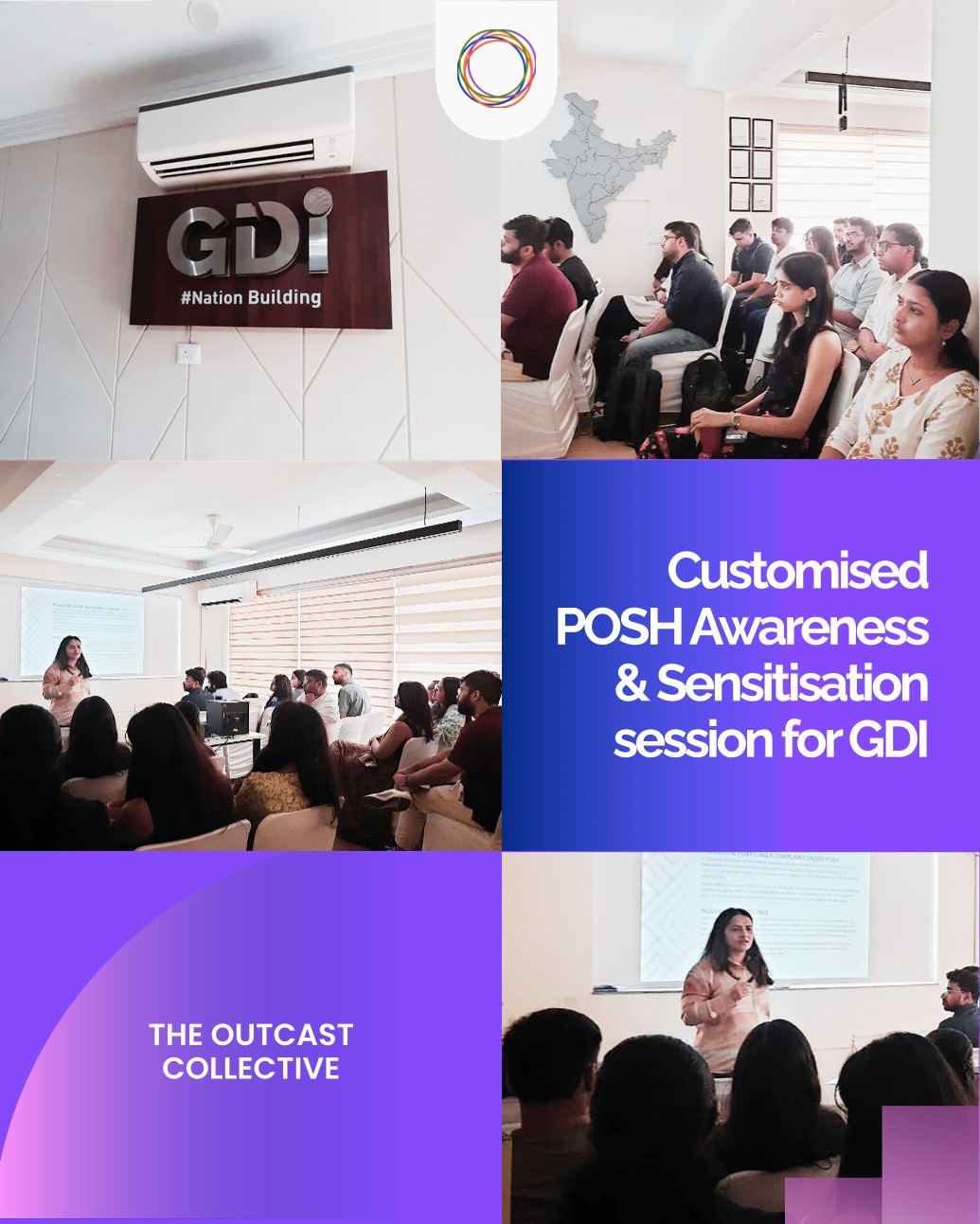
GDi‘s work involves engagement with diverse stakeholders, including vendors, partners, communities, and teams operating across field locations.
In such environments, professional interactions do not always happen within the boundaries of a conventional office. Employees may encounter different situations during field visits, official travel, project collaborations, and community-facing activities.
A standard office-centric training session might not adequately address these realities.
The objective, therefore, was to design a POSH awareness session that reflected the organisation’s working environment and helped participants understand how workplace safety and professional boundaries apply across different settings.
Rather than treating POSH as a policy employees simply needed to memorise, the session focused on helping them apply its principles in real-world situations.
How We Designed a Contextual POSH Awareness Session for GDi
1. Using Realistic Case Studies and Workplace Scenarios
One of the most effective ways to make POSH training meaningful is to connect legal principles with situations employees can recognise.
For GDi, the session incorporated practical caselets rooted in the organisation’s working context, including field visits, vendor interactions, official travel, project partnerships, and community-facing roles.
These scenarios encouraged participants to think about how inappropriate behaviour may arise in different professional settings and how they should respond.
Scenario-based learning helps move the conversation beyond theoretical definitions towards a clearer understanding of appropriate workplace conduct.
2. Understanding That Workplace Safety Extends Beyond the Office
Workplace interactions do not take place exclusively within office premises.
Official travel, off-site meetings, work-related events, field assignments, and interactions with external stakeholders can all raise questions about professional conduct and workplace safety.
The session explored how POSH protections and responsibilities may apply in work-related contexts beyond the conventional office.
Under the POSH Act, 2013, the concept of a workplace includes a broader range of work-related locations and circumstances. The applicability of the Act depends on the relevant facts and legal provisions, rather than simply whether an interaction occurs inside an office.
Helping employees understand this broader context is essential to developing a more informed approach to workplace safety.
3. Addressing Power Dynamics and Professional Boundaries
Workplace relationships are influenced by hierarchy, authority, professional dependence, and differences in power.
These dynamics can become particularly important when employees interact with senior stakeholders, vendors, partners, or individuals outside their immediate teams.
The GDi session addressed power dynamics, hierarchies, professional boundaries, and third-party interactions.
Participants were encouraged to consider how these factors can influence workplace behaviour and why respectful professional conduct must extend to every interaction.
Recognising these dynamics is an important step towards building a workplace culture where people understand the impact of their actions and take responsibility for maintaining appropriate boundaries.
4. Making Reporting and Redressal Mechanisms Clear
Awareness is meaningful only when employees understand what they can do if they experience or witness inappropriate behaviour.
A POSH awareness session should therefore explain the organisation’s reporting channels, the role of its Internal Committee (IC), and the available redressal process.
For GDi, making reporting and redressal mechanisms clear and accessible was a key focus.
Employees need to understand where to seek guidance, how to access the appropriate reporting mechanism, and what to expect from the process.
Clear communication can help reduce uncertainty and make employees better informed about their rights and responsibilities under the organisation’s POSH framework.
5. Recognising Behaviour Before It Escalates
Not every uncomfortable interaction immediately becomes a formal complaint. However, everyday behaviour can influence whether people feel respected, supported, and safe at work.
Inappropriate comments, disregard for personal boundaries, and conduct that creates an uncomfortable environment deserve thoughtful attention.
The session encouraged participants to recognise behaviours that may undermine workplace safety and to develop a clearer understanding of respectful professional interactions.
The objective was not simply to explain what constitutes sexual harassment under the law, but also to encourage greater awareness of the behaviours, boundaries, and responsibilities that contribute to a respectful workplace.
Importantly, recognising discomfort and understanding the legal definition of sexual harassment are related but distinct. Training must help employees understand both without treating every uncomfortable interaction as automatically constituting a legal violation.
Why POSH Training Must Include Everyone
POSH awareness should not be limited to HR professionals, Internal Committee members, or employees who are directly responsible for handling complaints.
Every employee has a role in contributing to a safe and respectful workplace.
A comprehensive awareness programme should help employees understand their rights, responsibilities, reporting options, and the importance of professional conduct. Managers and leaders also need to understand their responsibilities in fostering a culture of accountability and responding appropriately to concerns.
By designing the GDi session for a broader audience, the emphasis remained on shared responsibility rather than treating POSH as a policy that only a select group needs to understand.
When employees share a clearer understanding of workplace expectations, organisations are better positioned to make respectful behaviour part of everyday working life.
What Makes Customised POSH Training Different from Generic Training?
Generic training can establish foundational awareness of the POSH Act and organisational policies. However, a customised approach allows the learning experience to reflect the organisation’s actual working environment.
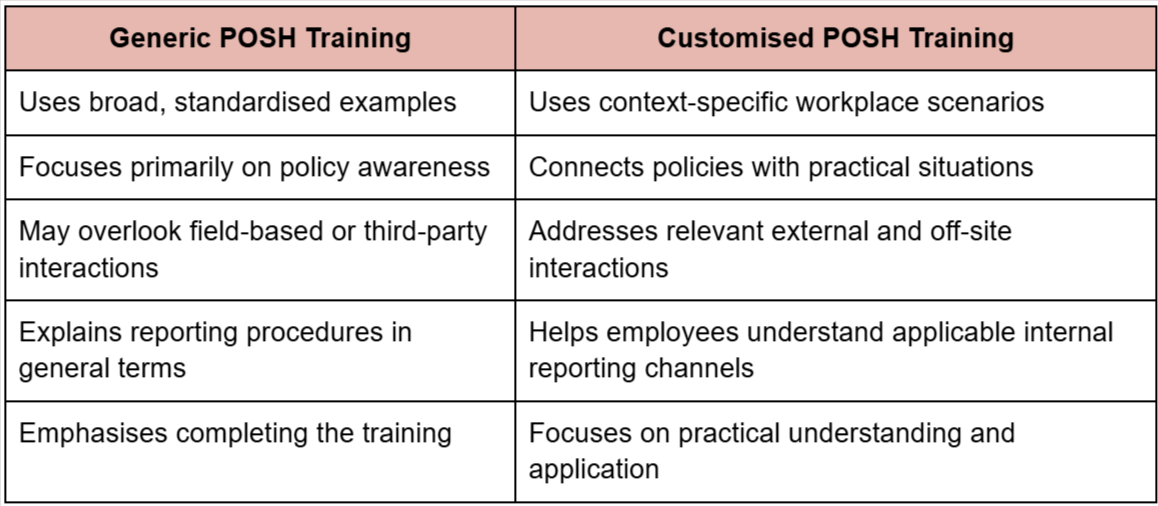
Customisation does not replace the legal requirements of POSH training. Instead, it helps make those requirements more understandable and relevant to the people expected to apply them.
For organisations operating across multiple locations or engaging with diverse stakeholders, this distinction can be particularly valuable.
Building a Culture of Workplace Safety Beyond Compliance
An effective POSH programme requires more than a well-written policy or a single awareness session.
Organisations need to reinforce their expectations through accessible reporting mechanisms, informed leadership, appropriately trained Internal Committee members, and regular awareness initiatives.
Customised training can contribute to these efforts by helping employees connect formal policies with their daily experiences.
For organisations such as GDi, where work involves field locations and interactions with multiple stakeholders, contextual learning helps bring important workplace safety principles into focus.
The broader goal is to ensure that employees do not merely know that a policy exists, but understand how to navigate professional situations with greater awareness, respect, and accountability.
How The Outcast Collective Approaches Customised POSH Training
At The Outcast Collective, we believe that effective POSH training begins with understanding the organisation.
Every workplace has its own structures, interactions, challenges, and learning requirements. A programme designed around these factors can make awareness and sensitisation more practical and relevant.
Our approach to POSH awareness and sensitisation focuses on:
- Context-specific learning: Aligning scenarios with the organisation’s work environment and employee experiences.
- Practical awareness: Connecting the POSH framework with situations employees may encounter.
- Clear reporting pathways: Helping participants understand applicable reporting and redressal mechanisms.
- Shared responsibility: Reinforcing the role of employees, managers, and organisational leadership in workplace safety.
- Inclusive participation: Making POSH awareness relevant to employees across roles and levels.
Our work with GDi reflects this approach: moving beyond a generic training format to create a session grounded in the realities of the organisation’s work.
Conclusion: Make POSH Training Relevant to Your Workplace
POSH training should not end when a session concludes. Its value lies in how well employees understand, retain, and apply what they learn in their professional lives.
The GDi engagement reinforced an important principle: workplace safety conversations become more meaningful when they reflect the environments in which people actually work.
By addressing realistic scenarios, power dynamics, professional boundaries, third-party interactions, and reporting mechanisms, organisations can make POSH awareness more practical and relevant.
Because there is a difference between training people on a policy and preparing them to recognise, respond to, and navigate real situations.
Looking to make your POSH training more relevant to your organisation’s reality?
The Outcast Collective works with organisations to design customised POSH awareness and sensitisation programmes aligned with their workplace contexts and learning needs.
Contact us at rutuja@theoutcastcollective.com to explore a training programme tailored to your organisation.
Learn more about our POSH Advisory and Awareness Training services.