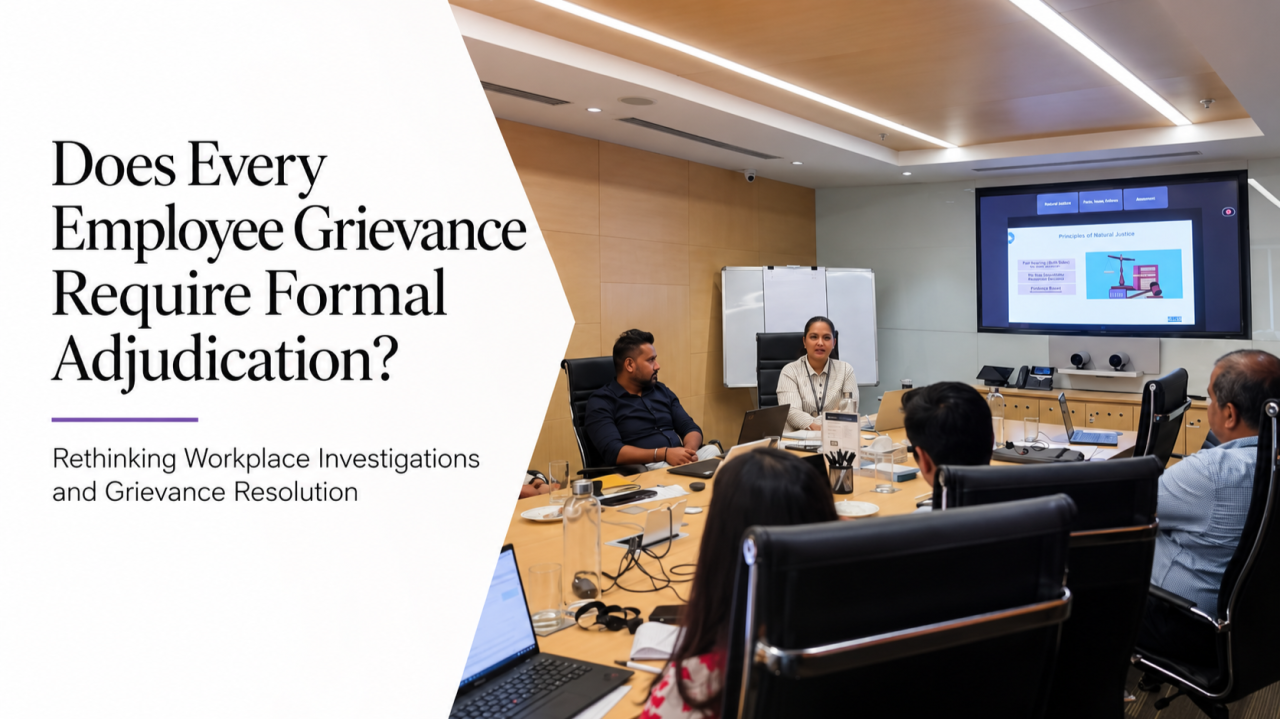
Employee grievances today span a wide spectrum. At one end are serious concerns involving fraud, misappropriation of funds, bribery, sexual misconduct or other potential violations of law and organisational policy. At the other are disagreements between colleagues over working styles, communication, team dynamics, interpersonal friction or differences in expectations.
While all these concerns deserve attention, they may not all warrant the same response.
For organisations, the challenge lies in distinguishing between matters that require formal investigation and adjudication, those that can be resolved through early intervention, and those that point towards a larger organisational or cultural issue.
The answer is not to formalise every grievance. Nor is it to resolve difficult concerns informally for the sake of convenience.
It is to build a redressal framework that is proportionate to the nature of the concern, the risks involved and the outcome that needs to be achieved.
1. Understanding the purpose of a domestic inquiry
A domestic inquiry is an important mechanism through which an organisation examines allegations of misconduct, evaluates the available evidence and provides the relevant parties an opportunity to present their respective positions in accordance with applicable law, service rules and organisational policy.
It serves a critical purpose: ensuring that decisions concerning alleged misconduct are based on a fair and structured process rather than assumptions, personal preferences or untested allegations.
However, a domestic inquiry is not merely a conversation between two employees facilitated by HR. It is a formal process that may involve defining the charges, issuing notices, recording statements, examining evidence, providing opportunities to respond, assessing credibility and arriving at reasoned findings.
Depending on the matter, it can require considerable time, specialist expertise, management attention and financial investment.
More importantly, a formal inquiry is designed to answer particular questions. Has the alleged misconduct occurred? Does the evidence support the allegations? Has a policy or service rule been violated? What action, if any, is warranted under the applicable framework?
Not every workplace disagreement requires these questions to be answered through a formal adjudicatory process.
Consider two scenarios.
In the first, an employee raises concerns that a colleague has repeatedly made inappropriate remarks despite being asked to stop. There may be questions of misconduct, workplace safety and potential policy violations that require a structured investigation.
In the second, two colleagues report that their working relationship has deteriorated because one prefers frequent updates while the other considers these unnecessary and intrusive. There may be frustration, mistrust and a genuine impact on team productivity, but the underlying issue may be a lack of clarity about roles, communication expectations or working arrangements.
Treating both matters as identical grievances requiring the same process would overlook a fundamental distinction: the nature of the concern and the intervention required to address it.
2. Four considerations before initiating a formal inquiry
Before deciding on the appropriate response, organisations should assess the following factors.
A. What is the risk involved?
The first consideration should be the nature and gravity of the alleged conduct and the risk it poses to individuals, teams and the organisation.
Is there a potential risk to an employee’s physical or psychological safety? Is there a possibility of repeated conduct, retaliation, intimidation or further harm? Could the alleged conduct affect other employees, compromise organisational integrity or expose the organisation to legal or regulatory consequences?
For instance, allegations involving bribery, financial misconduct, serious harassment or deliberate falsification of records may require prompt, structured investigation and appropriate interim safeguards.
By contrast, a disagreement over work allocation may be better addressed through a facilitated conversation, provided there are no underlying allegations of bullying, discrimination, retaliation or other misconduct.
Importantly, the absence of an immediate or obvious risk does not automatically make a matter suitable for informal resolution. Some patterns of behaviour may appear minor when viewed individually but reveal a more serious concern when considered collectively.
Similarly, an allegation does not have to be proven before an organisation takes reasonable steps to protect employees or preserve relevant evidence.
The risk assessment should therefore consider the available information, the potential consequences of the alleged conduct and the possibility of recurrence. It should also be revisited as new information emerges.
B. Does the matter fall within a formal policy or legal framework?
The second consideration is jurisdiction: what exactly is being alleged, and which framework governs the response?
Organisations typically have several policies and procedures that address workplace conduct, including the Code of Conduct, Ethics Policy, POSH Policy, anti-bullying provisions, disciplinary rules and grievance redressal mechanisms.
The nature of the allegation determines which process may apply.
For example, a complaint of sexual harassment that falls within the scope of the POSH Act, 2013, must be dealt with through the statutory mechanism prescribed under the Act. It cannot simply be redirected to mediation because the parties know each other or the organisation wishes to resolve the matter quickly.
Similarly, allegations of financial misconduct may require an independent investigation, an audit-led review or a disciplinary process, depending on the circumstances and applicable rules.
Other concerns may fall outside a formal disciplinary framework but still warrant intervention by HR or management.
The key is to distinguish between a matter that requires formal adjudication and one that requires organisational action through another appropriate channel.
A concern should not be dismissed merely because it does not fit neatly into one policy. Nor should the absence of a specific policy provision become a reason to avoid addressing behaviour that is affecting the workplace.
Where statutory obligations, disciplinary rules or mandatory reporting requirements apply, these must take precedence over informal resolution preferences.
C. Is this misconduct, an interpersonal dispute or a systemic issue?
The third consideration is the nature of the problem itself.
Not every conflict is evidence of misconduct. Equally, not every concern described as an interpersonal disagreement is merely a personality clash.
Organisations need to understand the distinction.
An interpersonal dispute may arise from differences in communication styles, expectations, work preferences or perceptions. In appropriate circumstances, these concerns can be addressed through facilitated conversations, mediation, coaching or clarification of roles and responsibilities.
A conduct issue, on the other hand, may involve behaviour that violates an established standard or policy and requires a formal determination.
There is also a third category: systemic issues.
Suppose multiple employees from the same team raise concerns about unreasonable deadlines, inconsistent allocation of work or a manager’s communication style. Each grievance may initially appear to be an individual disagreement. However, the recurring pattern could point towards unclear expectations, poor management practices, inadequate processes or a broader cultural concern.
Investigating every grievance separately may not, by itself, address the underlying problem.
In such cases, organisations may need to combine individual grievance handling with a broader review of team practices, management capability or organisational culture.
The objective should not be to force every workplace concern into a disciplinary framework, but to identify the nature of the issue and select a response that can meaningfully address it.
D. What outcome does the organisation need to achieve?
The final consideration is the outcome.
Is the organisation trying to establish whether misconduct occurred? Determine whether disciplinary action is warranted? Restore a working relationship? Clarify boundaries? Improve managerial conduct? Or identify a systemic failure?
The process should be aligned with the question that needs to be answered.
If an allegation requires a finding on misconduct, a formal investigation may be necessary. If the concern relates to a breakdown in communication and both parties are willing to participate, a facilitated conversation may be more effective.
If the issue stems from a lack of managerial capability, coaching or training may be appropriate. If several grievances point towards a recurring organisational problem, a policy review or culture assessment may be required.
This is where proportionality becomes central.
The seriousness of the concern, the risk involved, the applicable framework and the outcome sought must be assessed together. The least resource-intensive option is not necessarily the right one, and the most formal option is not automatically the fairest.
An intervention is effective only when it is appropriate to the problem it is intended to resolve.

3. What are the alternatives to formal adjudication?
Where a matter is suitable for informal resolution and no legal, policy or safety consideration requires a formal process, organisations have several options.
Facilitated conversations: A neutral HR professional can help employees articulate their concerns, clarify expectations and agree on practical ways of working together.
Mediation: A trained, impartial mediator can help parties understand their respective perspectives and work towards a mutually acceptable resolution. Organisations can invest in building internal mediation capabilities, provided the individuals facilitating these processes are appropriately trained, impartial and free from conflicts of interest.
Managerial intervention and coaching: Where the issue arises from unclear expectations, communication gaps or inadequate management capability, coaching can help address the underlying cause.
Boundary-setting and workplace agreements: In some situations, parties may benefit from clearly defined expectations regarding communication, professional conduct, responsibilities and future interactions.
Training and systemic intervention: Where the concern reflects recurring capability gaps, team-level dysfunction or broader organisational practices, targeted training, management support or a review of existing processes may be more effective than treating every instance as an isolated dispute.
However, these alternatives must not become convenient substitutes for accountability.
Mediation is not appropriate in every case, particularly where there is a significant power imbalance, coercion, intimidation or an allegation that requires formal determination. An apology should not be used to close a serious allegation without examining the circumstances. Nor should employees be pressured into reconciliation simply because a formal inquiry is time-consuming.
Informal resolution must be voluntary where required, suitable to the circumstances and supported by safeguards that protect the parties involved.
The availability of alternatives should strengthen the redressal framework, not weaken it.
4. What should organisations train their stakeholders to recognise?
A significant part of effective grievance management lies in building the capability of the people who receive and assess workplace concerns.
HR professionals, managers, ethics teams and other first points of contact should be equipped to distinguish between an allegation of misconduct, an interpersonal conflict, a policy concern and a potential systemic issue.
This requires more than familiarity with the organisation’s policies.
Stakeholders should understand the fundamentals of workplace investigations: what an investigation is designed to establish, what falls within its scope, how evidence should be handled, when impartiality or independence is required, and when specialist or statutory processes must be followed.
They should also be trained to recognise when early intervention may be appropriate, how to facilitate difficult conversations, when mediation may be considered and when a concern must be escalated for formal assessment.
Equally important is documentation.
Even when a matter is resolved informally, organisations should maintain appropriate records of the concern, the assessment undertaken, the intervention adopted and any agreed follow-up, subject to confidentiality and data protection requirements.
Where a decision is made not to initiate a formal investigation, the rationale should be recorded. This is particularly important when the concern involves potentially serious conduct, recurring behaviour or an allegation that could reasonably require further examination.
The decision to proceed informally should be reasoned, not arbitrary.
Organisations should also monitor whether the intervention has been effective. Has the behaviour stopped? Have the parties been able to work together appropriately? Has there been any retaliation? Does the matter reveal a broader concern that requires further action?
Closing a grievance administratively is not the same as resolving it.
5. Building a proportionate grievance redressal framework
Ultimately, organisations need a framework that balances formal investigation with early and informal resolution.
Such a framework should establish clear escalation pathways, define the roles of HR and other stakeholders, identify matters requiring mandatory or specialist processes, and provide guidance on the circumstances in which alternative interventions may be appropriate.
It should also allow for reassessment. A matter that initially appears to be an interpersonal disagreement may reveal allegations of misconduct during a facilitated conversation. In such circumstances, the organisation must be prepared to pause the informal process and consider the appropriate formal response.
Similarly, an informal intervention that fails to resolve the concern may need to be followed by a more structured process.
There is no universal formula that can determine the right response in every case. Context matters. The facts available at the time matter. The applicable legal and policy framework matters.
What organisations can establish, however, is a disciplined decision-making process that ensures grievances are assessed consistently, risks are recognised early, and the response is proportionate to the circumstances.
This can also help organisations use their resources more effectively, without compromising procedural fairness or employee trust.
The way forward
The objective of an effective grievance redressal system should not be to maximise the number of formal inquiries conducted. Nor should it be to minimise them.
It should be to ensure that every concern receives an appropriate response.
Some matters require rigorous investigation, reasoned findings and disciplinary action where warranted. Others may be resolved more effectively through mediation, coaching, facilitated conversations or systemic interventions. Some will require a combination of approaches.
The distinction lies in understanding the concern before deciding on the process.
For organisations, this calls for a shift from treating every grievance as a procedural event to viewing grievance management as an integral part of employee relations, organisational governance and workplace culture.
No grievance should be left unheard. But every grievance must be evaluated on its own facts, risks and circumstances.
Because fairness is not about applying the same process to every situation. It is about ensuring that the process adopted is appropriate, defensible and capable of achieving a just and effective outcome.
Take the first step today. Schedule an exploratory consultation via WhatsApp at +91 8928021419 or email rutuja@theoutcastcollective.com with our POSH experts and start building a workplace where everyone belongs.